


The Center For Hyperhidrosis
No More Excessive Sweating! More than 9,400+ Hyperhidrosis patients SWEAT FREE immediately after outpatient surgery! There is now a proven surgical solution for hyperhidrosis. This condition, which manifests itself as excessively sweaty hands, feet, or armpits, is now curable through state-of-the-art medical technology. The procedure is available and in practice at The Center for Hyperhidrosis in Beverly Hills, Los Angeles (LA), California.
World’s leading hyperhidrosis surgeons, Dr. Eraj Basseri, and Dr. Rafael Reisfeld, co-founders of The Center for Hyperhidrosis are experts in eliminating the discomfort and embarrassment of excessive sweating. The surgical procedures for hyperhidrosis are finely-tuned and take advantage of the latest endoscopic techniques, many developed at the Center for Hyperhidrosis.
Dr. Basseri perform the ETS (Endoscopic Thoracic Sympathectomy) for excessive hand sweating, which has a 99.2% success rate! He has is also the only surgeon in the United States that peforms the ELS (Endoscopic Lumbar Sympathectomy), which has a 99.2% success rate!
 Sweaty Palms | Sweaty Feet | Sweaty Armpits | Symptoms & Causes | Patient Success Stories | Younger Age Hyperhidrosis Is the procedure right for me? Find Out Quickly & Confidentially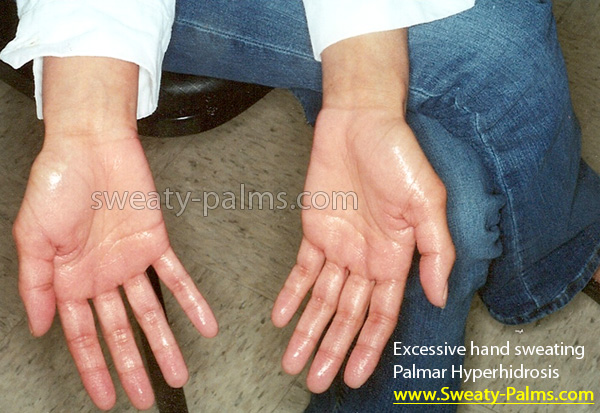
Popular Questions:
- How do I know if my sweating is considered hyperhidrosis?
- Can hyperhidrosis be cured on it’s own?
- What is the success rate of ETS?
- How much does the surgery cost?
- Can hyperhidrosis be corrected?
- Can all types of hyperhidrosis be cured with one operation?
- Does my child have hyperhidrosis?
- See more hyperhidrosis questions and answers like these.
Hyperhidrosis Facts:
- Hyperhidrosis affects between 1 and 2% of the world’s population.
- Family genetic history is believed to play a major role in hyperhidrosis. Almost 50% of those with hyperhidrosis have reported a family history of hyperhidrosis.
- The most common areas hyperhidrosis affects are the hands, feet, and armpits.
- The condition is the same across all races and genders.
- Higher percentages have been noted in certain geographic regions (Taiwan, Philippines, etc).
- Hyperhidrosis can negatively affect people both socially and functionally.
- The most effective long-term treatments for excessive sweating (in the hands, feet, or armpits) are surgical in nature.
- Historically, doctors have underestimated and or totally misunderstood hyperhidrosis.
- Continual advancements are being made in both medical technology and techniques.
- Conservative treatments in various centers have limited success rates.
Doctor Eraj Basseri – Hyperhidrosis Authority and Expert

Dr. Eraj Basseri
Eraj Basseri, MD, is an expert on innovative, minimally invasive surgical techniques. This includes the latest variations of hyperhidrosis surgery. Dr. Basseri is knowledgeable of the latest and most innovative surgical techniques and equipment available.
Instrumental in training and bringing the latest technology to patient care, he is a great addition to The Center for Hyperhidrosis.
Dr. Basseri is fiercely committed to providing his patients with the best and most individualized medical care possible within a warm and comforting environment. His friendly, easygoing approach and personal warmth put patients at ease the moment they meet him. His educational approach allows patients to better understand and become actively involved in their own medical care. Learn more about hyperhidrosis expert Dr. Basseri.
Doctor Rafael Reisfeld – A Hyperhidrosis Authority and Expert

Dr. Rafael Reisfeld
Dr. Rafael Reisfeld, M.D., F.A.C.S., A.B.M.S., is a Board-Certified surgeon, diplomat of the American Board of Surgery, and known worldwide as an authority in the unique field of hyperhidrosis.
Dr. Reisfeld was one of the first doctors to perform the ETS procedure. He continues to perform this surgery, as well as the latest developed techniques, on a daily basis. He, along with Dr. Basseri, are the only known doctors in the U.S currently performing the very effective and unique lumbar sympathectomy procedure for excessive foot sweating.
Dr. Basseri, along with Dr. Reisfeld, are the only U.S doctors that perform all three separate procedures for the hands, feet, and armpits. Dr. Reisfeld is continually published in various medical journals and has been interviewed by various media outlets. These include, but are not limited to Newsweek Magazine, Fox News, CBS, and many others seeking his expertise and knowledge in this field.
Dr. Reisfelds primary focus is on helping those who suffer from hyperhidrosis. He is tirelessly working to improve the methods used to accomplish that goal. When it comes to hyperhidrosis, you are in the very best hands with Dr. Reisfeld. Learn more about hyperhidrosis expert Dr. Reisfeld.
What is Hyperhidrosis?
Hyperhidrosis is defined as a non-physiological and excessive amount of sweat produced by the body. It can be a generalized situation where excessive sweating appears all over the body, or focused hyperhidrosis where the excessive sweating is specifically in areas such as the hands, palms, armpits, feet, or the face.
Hyperhidrosis Treatments
The wish to control excessive sweating with simple means such as pills, lotions, and so on, is very old. Doctors have tried to treat excessive sweating with pills, lotions, deodorants, electric devices, acupuncture, and bio-feedback in the past.
The success rate with these treatments for severe cases of excessive sweating is extremely limited. Surgical treatments have been available for the last 50 to 60 years. The initial surgical approaches were quite invasive and had complications associated with them. Since the development of optical surgical equipment, endoscopic surgeries became the yardstick for different procedures.
Sympathectomies became a possibility. Thoracic (for hand sweating), as well as lumbar (for foot sweating), can now be done on an outpatient basis. There are minimal small incisions, and the patient can return to normal activity in a short amount of time. Dr. Reisfeld has been a world leader in the development of endoscopic thoracic sympathectomies, and now the lumbar sympathectomy.
Current Surgical Hyperhidrosis Treatments
For severe hand sweating, the endoscopic thoracic sympathectomy (ETS) is the preferred approach. For excessive armpit sweating as the sole symptom, then axillary suction curettage is the recommended method. For those who suffer from excessive foot sweating as the primary presentation, or when ETS did not help their sweaty feet, then a lumbar sympathectomy is offered as a surgical solution.
Learn more about each surgical solution below:
 Hand Sweating Surgical Solution (Endoscopic Thoracic Sympathectomy)
Foot Sweating Surgical Solution (Lumbar Sympathectomy)
Armpit Sweating Surgical Solution
Hyperhidrosis Causes
Since the 1990’s, as more cases were examined, it was realized that the most common denominator in hyperhidrosis is a genetic predisposition. In papers written by both Dr. Reisfeld and other authors, it has consistently been shown that 50% or more patients have some genetic history in their families.
It is not always in successive generations as we have seen it skip generations in the past. Other causes, such as anxiety and dietary choices, have not proven to be a factor. On the other hand, some trauma to the head and chest area can be traced to the source of hyperhidrosis in a very small amount of cases. There are other factors that may contribute to generalized total body hyperhidrosis. These include obesity, hyper thyroidism, infections, diabetes, etc.
Learn More About
Hyperhidrosis Causes and Symptoms
Since genetic factors are the most important factor in regards to excessive focal sweating, it is the belief of our surgeons that one-day genetic manipulation will be the ultimate treatment method. Unfortunately, at present, this is a very distant hope. The knowledge and technology are still in the stages of their infancy.
For any potential patient who suffers from severe excessive sweating, it is extremely important to talk with the surgeon who performs the operation first. Any staff members (for example nurses, office managers, and or personnel who do not perform the procedure) are not equipped to answer your questions appropriately.
Learn More About:
Rafael Reisfeld – Recognized Hyperhidrosis Authority
News Coverage of The Center For Hyperhidrosis
Hyperhidrosis History:
As in any other medical problem, attention was first given to the conservative treatment of excessive hand sweating. Physicians and medical personnel attempted many conservative non-surgical modalities for the treatment but due to the extremely limited success of those treatments attention was given to the surgical possibilities which pushed the thoracic sympathectomy into reality. Obviously at the beginning the operations were done with an open surgical technique which rendered those operations somewhat more extensive and difficult to recover from but after the emergence of endoscopic surgery in the mid 1990’s the endoscopic approach made it much easier to perform those operations on an outpatient basis with excellent end results.
Initially, the treatment for palmar hyperhidrosis was based on the elimination of the T2 sympathetic ganglia (nerve). This describes the anatomical location of the nerve segment responsible for this excessive sweating. Since about the late 1990’s, new knowledge has changed the focal treatment to the levels T3-T4, which describes a segment somewhat lower to the one described above.
This change, and the utilization of titanium clips vs. destroying the nerve segment, improved the current treatment. Another improvement, is that now there are different surgical procedures available for different types of focal hyperhidrosis (Hands, Armpits, Feet).
Success Stories – Life Will Never be The Same
“Meet my hero! This picture was taken this morning after a surgery I had for a genetic disorder called hyperhidrosis.”
Jessica Read More From Jessica
“I admire your impeccable professionalism and your utmost skill in the performance of this highly technical and precise surgical procedure. I have waited many years since I was a young girl to properly get rid of this problem. My knowledge as a dermatologist led me to the best procedure and to the best doctor.”
Ligaya.B, M.D. Read More From Doctor Ligaya
“I am still in awe every single day at the miracle of my dry hands. I have been able to go back to church without the anxiety of having to shake or hold hands during the service. I happily hold the hands of my third graders and shake hands with their parents with confidence.”
Carolyn.B Read More From Carolyn
“My feet, of course, no longer sweat. My shoes don’t smell, my socks are dry, and most amazingly my underwear is also dry. My underwear has always been wet from sweat. I cannot be happier with the results. Thank you Dr. Reisfeld for all you do in helping people that suffer like I did.”
Michael Read More From Michael
“I want to thank you, Dr. Reisfeld, for going into this practice to help us “rare” people with this thing called hyperhidrosis. I am so thankful that you decided to make this your calling. It is truly a blessing. I will continue to tell people with this dreaded condition of what you have done for me.”
Tara Read More From Tara
For the first time in almost 40 years, my hands and feet were not only dry but also warm to the touch, something I had never felt before! Never will I forget awakening from that procedure, touching my dry hands, my dry feet. and to my surprise, a very warm and dry face! It was a feeling of elation that I haven’t felt since!
“I had the ETS surgery for palmar hyperhidrosis in 2003, and wanted to thank you and your staff for all of your help. Taking a standardized test in the past was nearly impossible without handing in a sopping wet ScanTron sheet. Since my surgery date, I was able to take the paper and pencil medical school entrance exams. I applied to medical school, and now I am a second year medical student in Ohio! This surgery changed my life.”
Sarah Read More From Sarah
“I would also like to thank all of your staff for such a pleasant experience. They were very friendly and helpful from the first time that I made a phone call to your office, up to the time in the recovery room. Everyone made me feel very comfortable and well taken care of.”
Peggy.P Read More From Peggy
Read from several touching thank you letters Dr. Reisfeld has received over the years since 1996.
 | |
New Paper Supports Effectiveness of Lumbar Sympathectomy In a recent paper, two groups of surgeons from both Austria and Brazil came to the same conclusion in regards to the surgical treatment of severe plantar (foot) hyperhidrosis. In this new paper, 130 patients were followed up with after an endoscopic lumbar sympathectomy. The success rate is as high as the results Dr. Reisfeld published in his paper (Approximately 97% Success Rates). The surgical techniques used were very similar. Some post operative pain (neuralgia) in the upper thighs was reported in about 10 to 15% of the patients, but this pain was of a temporary nature and soon went away. This important paper correlates well with Dr. Reisfeld’s lumbar sympathectomy paper, and supports the fact that the lumbar sympathectomy is an excellent treatment for patients with severe plantar hyperhidrosis who are not responding to conservative medical treatment. | |
| Phone: | (310) 557-3037 |
| Fax: | (310) 557-3554 |
Additional Information: » Sitemap » Contact Information » Website Disclaimer » Hyperhidrosis Treatment
Please consult your doctor before considering any medical treatment. Hyperhidrosis presents many choices and important decisions so please consult your doctor.
The information on this site is not to be used for diagnosis and or treatment, or to be used in place of professional medical advice from your doctor or physician. This web site is intended as an introduction to Endoscopic Thoracic Sympathectomy. When considering this or any surgical procedure, consult with your surgeon for any additional information regarding the surgery, risks, complications, recovery and results. Please view our full disclaimer.
Hyperhidrosis Questions:
For questions please fill out the form on our contact us page so we can better understand your condition in order to better answer your questions.